
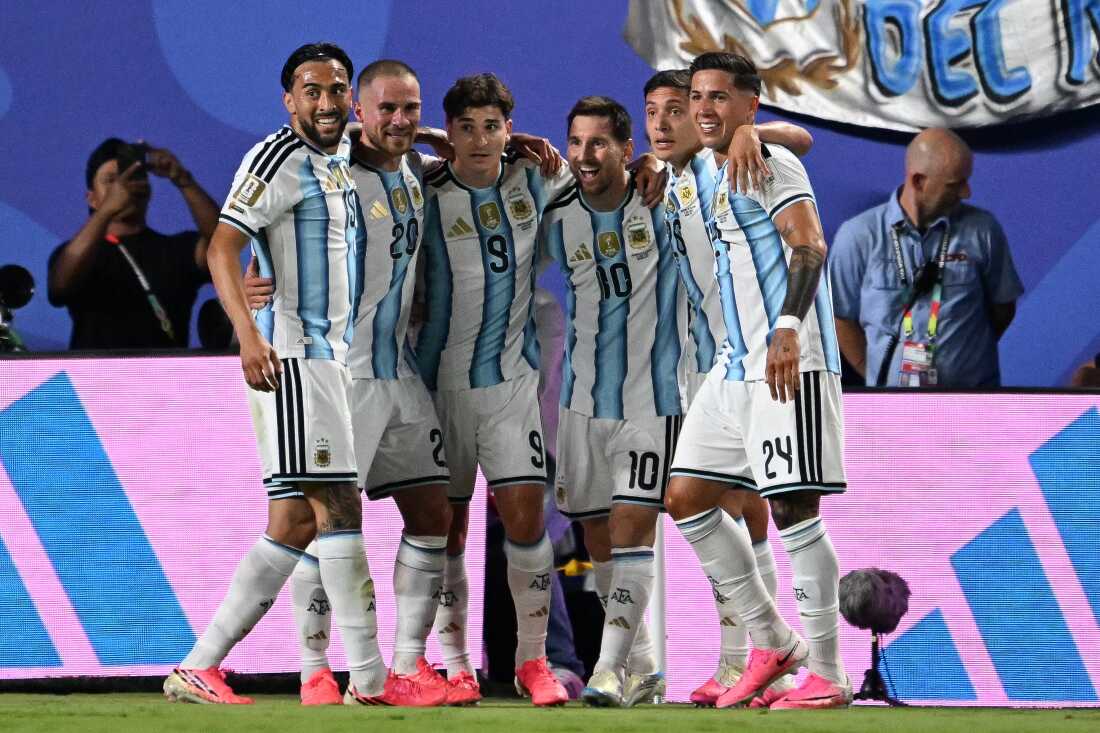
Lionel Messi has broken the World Cup scoring record, scored every Argentina goal of this tournament, and arrived in North America in blistering form. His greatness is beyond dispute, and quite frankly, I rejoice every time I watch him score, especially since he’s in my World Cup Fantasy Football lineup. The concentration of responsibility around him, though, is harder to ignore.
There was a moment in Argentina’s 2–0 victory over Austria this week when Messi’s World Cup story seemed to contain every familiar ingredient: a missed penalty, a brief spell of discomfort, then a decisive intervention from football’s most inevitable man, and by full-time, Messi had scored twice.
His first goal took him beyond Miroslav Klose’s record. His second took him to 18 World Cup goals, moving him clear of Marta’s overall record across the men’s and women’s tournaments. A few days earlier, he had begun Argentina’s title defence with a hat-trick against Algeria. Five Argentina goals. Five Messi goals.
It is a staggering feat for a player who turned 39 this week during this tournament. It is also the source of a question Argentina may not need to answer yet, but cannot avoid forever: what happens when the team’s attacking universe no longer has Messi at its centre?
Argentina are not a one-man team. Their defending has been disciplined, their midfield has control, and they have secured qualification from Group J with two clean sheets. But in the opening two matches, they have unquestionably been a one-man finishing attack.
Focal point
Messi’s start to the tournament is not merely prolific. It is overwhelmingly dominant. Argentina recorded 10 shots against Algeria and 12 against Austria. Messi attempted six in the first match and seven in the second. Across the two games, he has taken 13 of Argentina’s 22 shots: 59 per cent of the team’s total.
He has also scored all five goals.
Those numbers are a monument to Messi’s longevity and ruthlessness. But they also expose a potentially awkward reality for Lionel Scaloni: Argentina’s other attackers have not yet become meaningful final destinations for the team’s best moves.
This is not a criticism of Messi. Criticising a player for converting chances, breaking records and carrying the belief of an entire country would be football’s least intelligent hobby. The concern lies elsewhere. It is what Argentina’s success is teaching the rest of the team to do since the answer increasingly appears to be simple: find Messi.
Alexis Mac Allister put it plainly after the Algeria win, saying that Argentina had built a team around Messi in which he could feel comfortable. Julián Álvarez, meanwhile, called him “the best in history” after the Austria match.
Scaloni’s language is perhaps the most revealing. “When Leo becomes active, everyone activates,” he said after Austria.
That admiration is understandable. It is repeatedly rewarded. But it may also be shaping Argentina’s decision-making in the final third.

Messi as Inter Miami’s centre of gravity
This concentration of influence is not unique to Argentina. Messi entered the World Cup after producing 12 goals and eight assists in 14 MLS appearances for Inter Miami CF. He had directly contributed to 20 goals before MLS paused for the tournament, a return that made him the league’s leading attacking force.
At Inter Miami, Messi is scorer and creator. He drops into midfield, dictates tempo, releases runners, takes set pieces, and arrives in the penalty area to finish moves himself. He is the attack’s engine, steering wheel and emergency exit.
Argentina’s World Cup dependence is slightly different. Messi has been the finisher in every successful Argentina move, but he has also continued to create opportunities for teammates. The difference is that Argentina’s teammates have not yet converted that service into goals. It gives the attack an unusually one-way feel.
The Super Liga prelude
There was a small but revealing rehearsal for this World Cup inside Inter Miami’s training ground.
As reported by The Athletic, Inter Miami coach Guillermo Hoyos introduced an in-house competition, calling it the Super Liga after taking charge. Players were split into small-sided teams, captains selected squads, players could be transferred, and results and scoring totals were tracked on a whiteboard. It was designed to create edge and intensity during training, but Messi turned it into another reminder of the hierarchy around him. His team won the competition, while Messi reportedly scored more than 80 goals across the tournament. No other Inter Miami player reached 30.
The Super Liga does not prove that Inter Miami instructed teammates to serve Messi. But it does offer a fascinating prelude to what followed: even in an internal setting designed to sharpen the entire squad, Messi’s end product became absurdly disproportionate.
That form carried into Inter Miami’s actual matches. According to The Athletic, Messi was involved in 12 goals across his final five club appearances before the World Cup, scoring five and assisting seven. So the pattern is familiar.
Messi is not simply the player teammates look for when the move reaches its decisive moment. He is the player whose form can reorganise the confidence of everyone around him. That is the strength of Messi-centred football. It can make an entire squad believe that every attack has a solution. It is also the danger. Once that belief becomes automatic, the line between trusting the best player and waiting for him to rescue every move begins to blur.
Argentina to Messi, Messi to Argentina
Argentina have consistently created conditions for Messi. The problem is that they have created almost no end product for anyone else. The official assist record is revealing. Argentina have registered three assists in the opening two matches, where every official Argentina assist has supplied Messi.
Even that does not capture the entire picture. Alexis Mac Allister’s shot was spilled before Messi scored against Algeria. Thiago Almada’s dummy helped open the lane for Messi’s first goal against Austria. Julián Álvarez’s late shot was saved before Messi reacted quickest to the loose ball and sealed the victory.
Messi has also created openings that his teammates have not converted. He made two chances against Algeria, more than any other player in that match, and remained heavily involved in linking Argentina’s attacking sequences against Austria. However, we’ve still got the notion of:
Argentina to Messi: five goals.
Messi to teammates: no goals.
Two games are not enough to diagnose a permanent tactical illness. But they are enough to identify a pattern worth watching.
Scaloni’s 4-4-2, and the hierarchy within it
Argentina have started both matches in a 4-4-2. On paper, that suggests a conventional strike partnership, with Messi alongside Lautaro Martínez. But in practice, it is much less equal than that.
Messi is given the freedom of a second striker, a right-sided playmaker, and an advanced No. 10 at once. He can drift towards the right half-space, drop between midfield and defence, conserve energy without becoming Argentina’s first presser, and arrive late in the penalty area.
Someone else has to pay for that freedom. That is where Lautaro, Álvarez, and the supporting cast enter the picture. Their roles are not unimportant. They are essential. They stretch defences, press from the front, occupy centre-backs, make runs that open lanes and generate the disorder from which Messi thrives.
Lautaro won the penalty Messi missed against Austria after bursting into the area. Almada’s movement cleared the lane for Messi’s opener in the same match. Álvarez’s shot helped create the second.
They are valuable, intelligent actions. But they are also actions that always make Messi the final recipient. The risk for Scaloni is not dependence in the crude sense. Argentina have enough structure to defend, progress the ball and control games without Messi touching every passage of play. The risk is more subtle: Argentina’s attackers may begin to see themselves as enablers before they see themselves as scorers. Call it institutionalised trust if you must.
At Inter Miami, the Super Liga offered a miniature version of that same phenomenon. In a competitive environment, Messi’s output became so disproportionate that belief in him could only grow. Argentina have brought that belief onto the World Cup stage. The best player should often be the first option but he should not always become the only ending a team can picture.
The Lautaro Martínez and Julián Álvarez question
The early numbers look harsh on Argentina’s two principal centre-forwards.
| Player | Minutes played* | Shots | Goals | Main contribution so far |
|---|---|---|---|---|
| Lionel Messi | 169 | 13 | 5 | Every Argentina goal; 59% of team shots |
| Lautaro Martínez | 119 | 1 | 0 | Won the penalty against Austria; provided depth, pressing and centre-back occupation |
| Julián Álvarez | 61 | 1 | 0 | Offered energy from the bench; his Austria shot began the sequence for Messi’s second |
*Minutes are calculated from substitution timings on a standard 90-minute clock and exclude added time.
Lautaro’s total is the more striking because he has started both matches. He has one shot in 119 minutes, despite arriving at the World Cup after finishing as Serie A’s top scorer with 17 goals in 30 appearances for Inter.
Álvarez’s sample is smaller. He has played 61 minutes, all as a substitute, and has attempted that one shot against Austria. At Atletico Madrid, he recorded eight La Liga goals and four assists in 1,902 minutes during the 2025-26 season. We are yet to see what his future has in store now that he’s requested to move.
Neither player has suddenly forgotten how to score. The more likely explanation is role allocation.
For their clubs, both forwards are expected to be finishing points. In this Argentina team, they are often asked first to run, press, connect, and disrupt. Their most valuable action may be the movement that allows Messi to arrive free.
While that does not make them lesser forwards, it does mean their Argentina output cannot be judged through the same lens as their club output. Lautaro’s lack of shots should concern Argentina more than it should concern Inter. Álvarez’s lack of shots should invite patience rather than panic.
Argentina can survive without Messi. Can they prepare for it?
The concern should not be exaggerated into a false claim that Argentina are helpless without Messi because the truth is, they are not.
In the 2024 Copa América final, Messi left injured with the score at 0-0. Argentina did not collapse and Lautaro scored the extra-time winner against Colombia to secure the title. In March 2025, Argentina beat Brazil 4-1 in World Cup qualifying without Messi and Lautaro. Álvarez scored, Enzo Fernández and Alexis Mac Allister found the net, while Giuliano Simeone completed the result. It was a reminder that Scaloni’s side can distribute responsibility when its biggest star is unavailable.
Argentina can survive without Messi. They have proved it. The question is whether their current tournament attack is rehearsing that possibility at all.
An injury to Messi would not simply remove five goals. It would remove 59 per cent of Argentina’s shot volume so far, their most reliable final-third reference point and the emotional certainty created by having the greatest player in the game waiting for the ball.
Retirement is the longer version of the same question. Argentina (or the footballing world in general) will not replace Messi with one player. That would be impossible. They will have to redistribute his responsibilities: Lautaro and Álvarez as more consistent finishing targets, Almada and Mac Allister as greater creative risks, and midfielders who can make decisions without instinctively checking where No. 10 is standing.

Final thoughts
A scout who judges Lautaro or Álvarez solely through Argentina’s World Cup goals, assists and shot totals could reach the wrong conclusion. Their low-volume output may say less about their ability than it does about the hierarchy they are operating within.
The right questions are different:
- Are their runs creating space for teammates?
- How effectively do they pin centre-backs and attack depth?
- Do they press with intelligence and intensity?
- Can they link play under pressure?
- Are they making the correct decision when Messi is available but another option may be better?
- What happens to their shot volume and penalty-box presence when Messi is absent?
A strong recruitment department should not dismiss these performances. It should treat them as evidence of adaptability, tactical sacrifice and intelligence.
But it must avoid confusing a supporting role with a limitation.
Lautaro Martínez and Julián Álvarez remain high-level forwards. Argentina’s opening two games have simply given them jobs that are less about applying the final touch and more about making sure Messi can.
Messi’s record deserves to be celebrated as a monument to a career that has escaped ordinary measurement. Yet the numbers beneath it offer a warning label.
Argentina are not a one-man team. For now, though, they are a one-man finishing attack.