
The Pros and Cons of Water Breaks
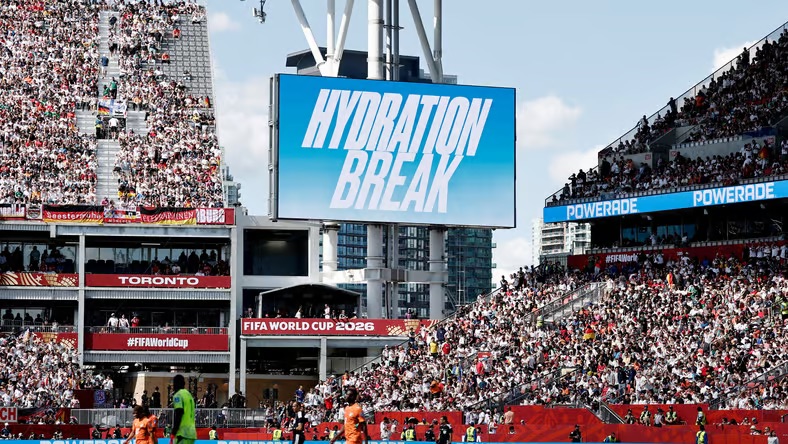
Football (let’s say soccer for American and Aussie readers) is traditionally a game of two halves. Stoppages in play usually come due to substitutions, goals, fouls, injuries, and, more recently, Video Assistant Referee (VAR) decisions. But at the 2026 World Cup, FIFA has reinforced something more deliberate: a compulsory three-minute hydration break in each half, scheduled around the 22nd minute and 75th minute, of every match.
It’s a small change on paper. Two short pauses. A chance for players to hydrate, cool down, and listen to instructions. Though, in practice, it may be much bigger than that.
The new format divides a match into four distinct passages. It is not quite a timeout like other sports, like basketball or hockey, because neither coach requests it, but it is closer to a quarter break: a scheduled interruption that arrives whether the game needs it or not.
That is why FIFA’s new policy has become one of the most interesting debates of this World Cup. The hydration breaks are a sensible response to genuine heat concerns. They may also be another step towards a more commercial, more fragmented version of football.

The Club World Cup warning
FIFA did not introduce the breaks in a vacuum.
Last year’s Club World Cup in the United States acted as a dress rehearsal for the World Cup, and the conditions were alarming. Players, coaches, and supporters repeatedly raised concerns about heat, humidity, and kick-off times.
During Paris Saint-Germain’s match against Atletico Madrid in Pasadena, Atletico midfielder Marcos Llorente described the conditions as “terribly hot”. He said his toes were sore and his nails were hurting, a vivid illustration of how extreme temperatures can affect players beyond ordinary fatigue.
Chelsea midfielder Enzo Fernández was even more direct after playing in New Jersey. He said he had felt dizzy enough to sit on the ground and described playing in such conditions as “very dangerous”. His concern was not simply about player comfort. He argued that the heat slowed the pace of matches and called for kick-off times to be reconsidered ahead of the World Cup.
Former Juventus coach Igor Tudor offered another revealing example after his side faced Real Madrid in Miami. He said 10 players had asked to be substituted because of the combination of heat, humidity, and the pressure of a knockout match.
The Club World Cup proved that heat was not a theoretical concern. It affected performance, recovery, tactics, and the quality of the spectacle itself.
FIFA did respond during that tournament by adapting cooling procedures and improving access to water and cold towels. The World Cup’s universal hydration-break rule is the clearest sign that the governing body took those concerns seriously.
A genuine player-welfare measure
There is a strong case for the breaks.
The World Cup is being played across the United States, Mexico, and Canada during the North American summer. Some venues face intense heat and humidity, particularly at afternoon kick-offs. Elite footballers may be exceptionally fit, but they are not immune to dehydration, heat exhaustion, or reduced decision-making that comes with a rising body temperature.
The breaks give players a chance to drink, cool down, and briefly recover. They also give medical teams a predictable point at which to monitor athletes who may be struggling.
FIFA’s argument is that applying the rule to every match creates equal conditions. A team should not face a hydration break in one city but not another. It is a simple rule for referees, players, and coaches to understand.
There is also an argument that football has to adapt to a hotter sporting world. The issue is not disappearing. Future major tournaments will continue to be staged in countries where summer temperatures can make traditional kick-off times difficult.
From that perspective, water breaks are not an American innovation or a commercial gimmick. They are an acknowledgement that football’s old assumptions about weather are becoming less reliable.

But why every match?
The problem is that FIFA has made the breaks compulsory regardless of the weather.
A three-minute stoppage occurs whether the match is being played in punishing heat, in mild evening conditions, or in a venue with a roof and cooling infrastructure. That is where the player-welfare argument becomes more complicated.
Dutch captain Virgil van Dijk captured the uncertainty around the policy when he said breaks made sense in genuine heat, but should be assessed on a match-by-match basis. Belgium midfielder Youri Tielemans made the opposite fairness argument: if some teams receive breaks, perhaps all should.
Both positions are understandable. But universal breaks can feel blunt. A pause designed for Miami heat may appear unnecessary in a cooler stadium thousands of kilometres away.
Medical experts have also questioned whether three minutes is enough when conditions become genuinely dangerous. The debate is not simply between people who care about players and people who care about tradition. Some specialists believe FIFA’s breaks should be longer, more frequent, or accompanied by bigger changes such as later kick-off times and longer half-time intervals.
That is the real challenge for FIFA. A water break may ease the symptoms of extreme heat without solving the underlying issue of scheduling matches during the hottest part of the day.
| Host city/stadium | Local extreme-heat threshold | Average extreme Jun–Jul days per year, 2016–25 | Stadium environment |
|---|---|---|---|
| Dallas, AT&T Stadium | 31.8°C | 8.9 | Fully climate-controlled |
| Houston, NRG Stadium | 30.4°C | 9.6 | Fully climate-controlled |
| Monterrey, Estadio Monterrey | 30.4°C | 7.7 | Open-air |
| Kansas City, Arrowhead Stadium | 29.3°C | 6.8 | Open-air |
| Miami, Hard Rock Stadium | 28.9°C | 11.9 | Open-air, partial shade |
| Atlanta, Mercedes-Benz Stadium | 28.7°C | 4.9 | Fully climate-controlled |
| Philadelphia, Lincoln Financial Field | 28.6°C | 6.9 | Open-air |
| New York/New Jersey, MetLife Stadium | 27.8°C | 7.4 | Open-air |
| Boston, Gillette Stadium | 26.5°C | 7.8 | Open-air |
| Guadalajara, Estadio Guadalajara | 26.2°C | 9.5 | Open-air |
| Los Angeles, SoFi Stadium | 26.0°C | 8.8 | Passive cooling |
| Toronto, BMO Field | 24.9°C | 6.5 | Open-air |
| San Francisco Bay Area, Levi’s Stadium | 24.2°C | 5.8 | Open-air |
| Seattle, Lumen Field | 21.6°C | 8.3 | Open-air, partial roofing |
| Vancouver, BC Place | 20.3°C | 7.6 | Retractable roof |
| Mexico City, Estadio Azteca | 16.8°C | 10.6 | Open-air |

Qatar vs North America
Back in 2022, Qatar staged its World Cup in November and December rather than the traditional summer window, with heat being a central part of the decision. Its stadium project also relied heavily on cooling and ventilation technology, designed to create more manageable conditions for players and supporters.
North America 2026 has taken a different path. Rather than cooling every venue or moving the tournament outside the summer period, FIFA has inserted scheduled pauses into the match itself.
Qatar tried to cool the environment around football. The 2026 World Cup is adjusting football’s rhythm to cope with the environment.
Which approach is better is not for me to say: Qatar’s stadium cooling attracted its own environmental and financial questions. But the difference matters because it shows how FIFA has moved from treating heat as a venue problem to treating it as a game-management problem.
From two halves to four quarters
The hydration breaks are not natural stoppages. They are scheduled, and that’s where the ‘four-quarters’ argument comes in. Everyone knows they are coming. Coaches can plan for them, players can conserve energy until them, and broadcasters can build their coverage around them.
England coach Thomas Tuchel has described the new reality as four quarter times. Belgium coach Rudi Garcia was even more revealing when he called the pause “a coaching break more than a cooling break”.
That is not necessarily a criticism. Managers have always looked for moments to communicate with players. But the new breaks formalise those moments.
A team that is struggling can reset. A coach can change instructions or calm a player who is losing discipline. A side that has just scored can be interrupted before it builds momentum. A team under pressure can use the pause to regroup.
The early match between Germany and Curaçao offered a glimpse of this tension. Curaçao equalised in the 21st minute, only for a hydration break to follow shortly afterwards. Germany had an immediate opportunity to reset, receive instructions, and respond, going on to win the match 7-1.
No one can claim the break alone decided the match. But it showed why supporters are uneasy. The scheduled pause can arrive at exactly the moment when a match is becoming emotionally unstable, which is often when football is at its best.
Uruguay coach Marcelo Bielsa has been among the strongest critics, arguing that playing in four sections rather than two changes something fundamental about football’s identity.
His point is not that players should go without water. It is that football’s uninterrupted flow is part of what makes it football.
The commercial shadow
The commercial concern is impossible to ignore.
Broadcasters are permitted to cut away to advertisements shortly after a hydration break begins, provided they return to the live match before play resumes. In the United States, Fox has used full-screen advertising during the breaks, creating a new in-game advertising slot in one of the world’s most valuable sporting events.
But the first match of the tournament provided an awkward example. Fox returned late from a commercial break during Mexico’s match against South Africa, briefly missing the restart. FIFA took no action, but the incident sharpened the suspicion that the breaks are serving television as much as player welfare.
Speaking to ZDF, former Liverpool and Borussia Dortmund coach Jürgen Klopp did not hold back: “Football is being held hostage by executives in air-conditioned offices. These so-called ‘cooling breaks’ were sold to us as a shield for the players’ well-being, a noble sword against the heat. But in reality? It’s nothing more than a gilded cage built for sponsors.”
The comparison with American sport is therefore understandable.
The NBA is built around four quarters, scheduled timeouts, and commercial breaks. The NFL has long turned pauses in play into valuable advertising inventory. Football has traditionally operated differently: two long halves, with adverts largely confined to before the match, half-time, and full-time.
The hydration breaks do not turn football into basketball, especially since they are rooted in a legitimate health concern. But they do introduce a familiar North American broadcasting logic: create predictable moments inside the action, and those moments become sellable.
Not every broadcaster has taken the bait
FIFA has created the advertising opportunity, but not all broadcasters have treated it in the same way.
ITV has chosen not to show adverts during hydration breaks, partly because of UK advertising restrictions and partly because viewers are used to uninterrupted football coverage. Telemundo, the Spanish-language World Cup broadcaster in the United States, has also avoided full-screen commercial breaks, keeping cameras on the players and coaches instead.
I’d like to make that distinction since the hydration break is compulsory and the advertising break is not. FIFA can reasonably argue that its rule exists for player welfare. But it has also created a new television precedent that broadcasters can exploit if they choose to. In a tournament already shaped by expanded formats, huge broadcast rights deals, and a Super Bowl-style half-time show at the final, it is understandable that some supporters see the excessive commercial direction.
Final thoughts
FIFA was right to learn from the Club World Cup. The 2025 tournament showed that football cannot treat extreme heat as an inconvenience. Players need better protection, and a World Cup played across North America in June and July requires more preparation than simply hoping the weather behaves. So, hydration breaks are not the problem in themselves. In genuinely dangerous conditions, they are common sense.
The concern is that FIFA has chosen a universal, scheduled solution that changes the rhythm of every match, including those where the medical need is less obvious. In doing so, it has created four distinct segments of football, tactical reset points for coaches, and valuable commercial windows for broadcasters.
Perhaps that is the unavoidable future of football in a hotter climate, or maybe FIFA has used a real welfare issue to make the game more compatible with its plan to match the kind of income coming from the commercialisation of American sport.