
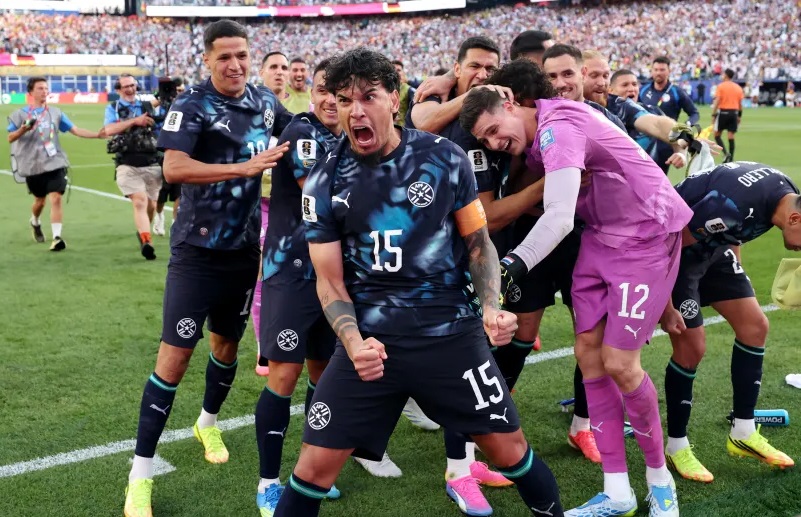
On Monday, Germany had the ball. Germany had the shots. Germany had the corners. Paraguay had control of the spaces that mattered. And Paraguay went through.
For long periods in Boston, Germany’s possession looked less like dominance and more like laps around a locked fortress. The ball travelled from side to side, full-backs pushed on and corners piled up. But in front of Orlando Gill’s goal, Paraguay had built a dense, disciplined barrier.
That is a clear World Cup pattern. Underdogs are not always trying to win possession from the favourites. They are deciding where it is allowed to happen, closing central access, flooding the area and waiting for the moment to change the tempo completely.
Low blocks and counter-attacks are hardly new but Germany’s exit showed how damaging they become when a team controls not only space, but rhythm.
The trap
Paraguay started the match in a 4-4-2, but their defensive picture often looked closer to a 4-5-1 or 4-4-1-1 once Germany settled on the ball. The objective was simple: protect the corridor in front of Gill, squeeze the space between the lines and leave Germany with width but little room to maneuver through the middle.
Paraguay were not trying to press every German pass. They were happy for Germany to circulate in front of their block, especially once the ball had crossed halfway. The South Americans were willing to let them switch play, push the full-back on and deliver from wide. But it was an invitation with a catch. Every lateral pass gave Paraguay time to shuffle. Every switch allowed the opposite winger to recover. And every cross was met by a crowd already facing the ball. A cross can always produce a goal, as Germany proved through Kai Havertz, but it becomes a lower-control route when the area is packed and second balls are fiercely contested.
FIFA’s Technical Study Group report makes the point brutally clear. Paraguay spent 50% of their out-of-possession time in a low block and another 16% in a mid-block. Germany recorded 344 final-third receptions and attempted 52 crosses across 120 minutes. Yet Paraguay still forced 59 turnovers. The aim was not to make Germany stop playing. It was to make Germany play the same phase again and again.
The objective is not to stop possession. It is to make possession repetitive.
Germany v Paraguay: the case study
| Metric | Germany | Paraguay |
|---|---|---|
| Possession | 76% | 24% |
| Shots | 21 | 7 |
| Expected goals | 1.57 | 0.35 |
| Touches in opposition box | 43 | 12 |
| Germany corners | 16 | — |
Opta data via FotMob. FIFA’s Technical Study Group uses a separate possession and xG model, including contested possession, but reaches the same conclusion: Germany had the territory; Paraguay protected the decisive spaces.
Several sequences throughout the 90 minutes captured the plan. Germany advanced beyond halfway and Paraguay’s outfield players collapsed towards their own area. Germany could move the ball from one side to the other, but the central lanes were screened and the box crowded. There was no easy through pass, no clean bounce into the striker and no clear route to the penalty spot.

Germany’s problem was less about effort than tempo. The pace of their possession was largely set by Paraguay. Germany circulated, Paraguay shuffled. Germany reset, Paraguay reset. Then, when the ball was lost or cleared, Paraguay sprang forward with much more urgency than they had shown while defending.
Their opening goal was not a classic counter-attack, and that matters. Miguel Almirón released Matías Galarza down the left, Galarza crossed and Julio Enciso headed in. But the threat of transition was still part of Paraguay’s control. Germany had to keep enough players behind the ball to respect it, while Paraguay knew they did not need long spells of possession to create one meaningful attack.
Gill was the final layer. He was composed under crosses, made key interventions late on and then saved penalties from Havertz and Nick Woltemade before Jonathan Tah fired over the bar. He was named FIFA’s Superior Player of the Match. When José Canale scored the winning kick, commentator Chris Wise called it “Paraguay’s most powerful World Cup result in their history”.

What Germany missed
Germany’s front line had enough talent to cause problems. Deniz Undav was making his first World Cup start, looking to connect attacks after having scored three goals off the bench. Leroy Sané repeatedly tried to stretch the game with runs down the wing. Neither found enough clean space to make the difference, and neither lasted the whole game without getting subbed off.
Undav often had a defender tight behind him and another body screening the return pass. Sané could receive wide, but his burst usually led him into a second defender, with cover already waiting in the box. Paraguay did not need to win every duel since they forced every action into traffic.
This is what Germany missed: not more possession, but sharper ways, and maybe better ideas, of changing the picture before attacking it. Faster switches only matter if they arrive before the block has shifted. Crosses need runners attacking different zones, cut-back options and overloads that create separation. Central combinations need third-man runs and rotations that drag a midfielder or centre-back out of the line.
Wirtz’s cross for Havertz’s equaliser showed that the plan was not invincible. But too often, the next German attack resembled the last. Paraguay were allowed to settle, set their line and defend the same ball.

The wider pattern
Ghana used a very similar idea against England earlier in the group stage. England had almost 79% possession and 19 shots, but Ghana’s 5-4-1 blocked the centre, protected the area and made the game feel slower than England wanted it to be. Ghana still kept enough pace on the break to make England cautious.
Cape Verde’s 0-0 draw with Spain on Matchday 1 was the same story at a different volume. Spain had 27 shots and nearly 75% possession, but Cape Verde protected the box relentlessly (Vozinha had the game of his life) and still created the two best late chances. Again, the underdog did not need the ball for long. It needed the favourite to become impatient with it.
That is the lesson for the tournament’s favourites. Possession is not control when the opponent has decided where your possession lives, how quickly it moves and what it is allowed to become.
Germany had the ball. Paraguay had the game.